

A composite deck in Australia, including Melbourne, lasts an average of 25 to 30 years. A well-planned composite decking installation in Melbourne starts with a suitable base and careful board placement, while colour helps determine how the deck sits with your home and garden.
Choosing boards involves more than finding a shade you like. Melbourne’s outdoor conditions make resistance to fading, staining and warping worth considering, alongside the layout and preparation of the installation area.
This guide explains what affects a composite deck’s lifespan, the colours available and how installation works, from preparing the surface to fitting and finishing the boards. You’ll also learn what to consider when comparing options, so you can choose a deck that suits your space and how you plan to use it.
Key Takeaways
- Composite decks in Australia, including Melbourne, last an average of 25 to 30 years. Consider how the deck’s colour will sit with your home and garden before choosing boards.
- For Melbourne’s outdoor conditions, prioritise boards designed to resist fading, staining and warping.
- Good installation starts with a clean, level base and accurate measurements. Consistent spacing helps support airflow and drainage.
- Board placement and compatible fasteners need to allow for expansion and contraction as temperatures change.
- Understand what your project needs, from surface preparation and framing to board fitting and finishing, before planning the work.
What Colours Are Available In Composite Decking Boards In Melbourne?
Composite decking colours generally draw on natural timber and neutral palettes, including brown, grey and charcoal. Available tones depend on the board range, so compare samples outdoors, where daylight and nearby brick, paving or greenery affect how they look. A warmer brown can complement timber features, while grey can create a quieter contrast with planting and light-coloured walls.
Colour is only one part of choosing materials for an Australian backyard. Melbourne’s changing outdoor conditions make resistance to fading, staining and warping useful qualities to consider. Compare the board’s surface, profile and cleaning requirements as well as its shade. Darker boards can stand out in a small courtyard, while a paler colour may make the same space feel more open.
Timber is another option. Hardwood, Merbau and Ipe each have distinctive grain and colour, and timber can be sanded or finished to achieve a chosen look. A timber deck also needs ongoing care to maintain its surface. Composite boards combine recycled wood and plastic, avoiding routine staining, sanding or sealing. Recycled content can reduce reliance on virgin raw materials, though the composition varies by product.
Solid-profile WPC, or wood-plastic composite, is one type of composite decking. The boards combine wood and plastic, but construction and finish vary, so compare product details before choosing. A solid profile may suit a design that calls for a more substantial-looking board edge. Consider colour and profile together, then think about how board direction, borders and nearby materials will shape the finished area.
What permits or council approvals are required for a deck in Melbourne? Approval depends on the proposed deck and site. The guidance states one metre for extending a deck to a fence and says special approvals are generally needed.
What building code requirements apply to decks, balustrades and stairs in Victoria? The design needs to address structural support, edge protection and safe access under applicable Victorian building requirements. The relevant details depend on the deck’s layout and connection to the home.
Before settling on a shade, take these practical steps:
- Compare colour samples outdoors against the house, paving and garden.
- Consider how the board profile will look at exposed edges and steps.
- Weigh recycled-material content, surface care and the visual character of timber alternatives.
Ready to Transform Your Outdoor Space with Composite Decking Melbourne Homeowners Trust?
A well-planned deck starts with the site, not just the board choice. In Melbourne, access, surface condition, drainage and how you use your outdoor space all shape the installation.
Melbourne service coverage
Access needs can differ between a narrow inner-city block and a large suburban garden. Consider the property’s location, how materials can reach the work area and whether an existing slab or timber deck needs attention. These details help define the installation scope and keep site preparation suited to the home.
Before planning, note the deck’s position, edges, steps and nearby doors. A simple sketch of these features can make it easier to discuss the layout and access. Melbourne properties vary, so the location and site conditions are more useful than relying on a broad city label alone.
Installer reviews and warranties
Which Melbourne composite decking installers have good reviews and provide warranties? Look for reviews describing completed composite decking projects, including board fitting, edges and site cleanliness. Compare written warranty terms separately for workmanship and decking materials: a product warranty and an installation warranty cover different things.
Reviews are most useful when they describe details relevant to your project, such as a raised deck, steps or a tight courtyard. Read the full account rather than relying on a rating alone. Clear written terms should explain what is covered, the coverage period and how to raise a concern.
Slip resistance and installation risks
For a wet outdoor area, choose boards with a surface texture suited to the intended use, then plan how water will drain away. An attractive, smooth finish alone doesn’t show how a board performs when wet. Consider walking routes, steps and transitions, especially where the deck meets paving or a doorway.
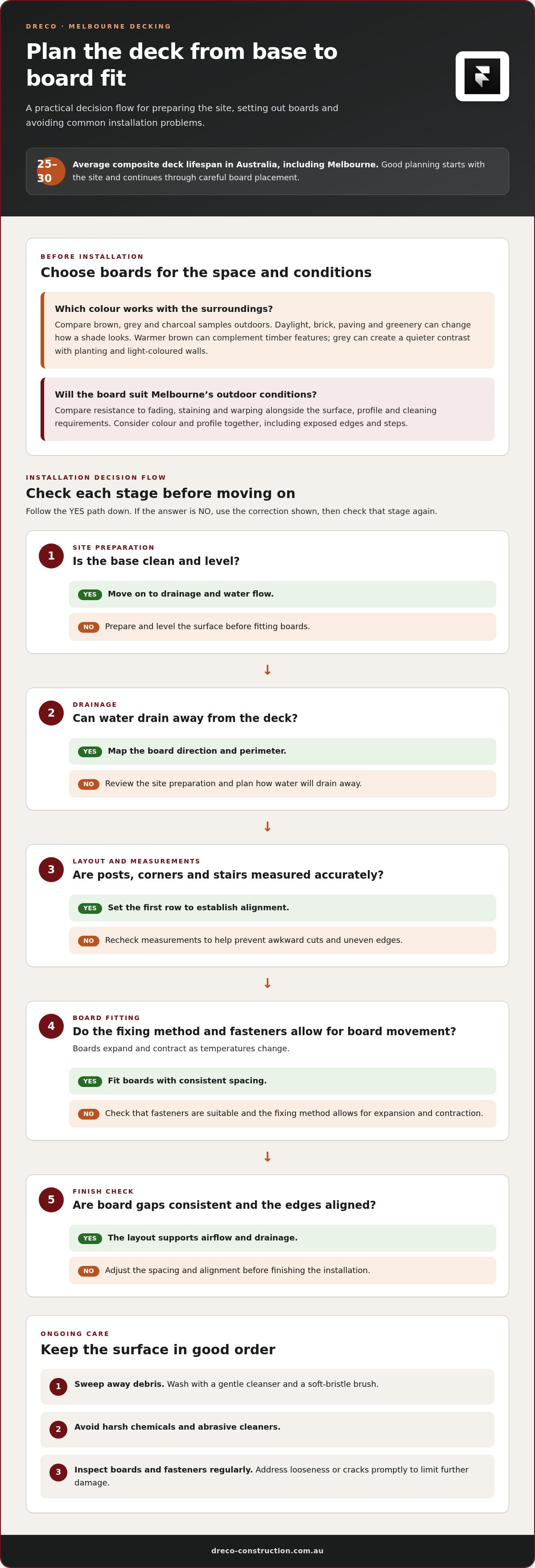
What are common risks and installation problems with composite decking? An uneven base, poor drainage, inconsistent board gaps and unsuitable fasteners can compromise the finish. Boards also expand and contract as temperatures change, so the fixing method needs to allow for movement. Accurate measurements around posts, corners and stairs help prevent awkward cuts and uneven edges.
For a considered layout, map the board direction and perimeter before installation. The first row sets the alignment for the rest, while consistent spacing supports airflow and drainage. Keeping offcuts and tools organised also helps protect the boards and surrounding garden during the work.
If you’re weighing up a new deck or a replacement, explore Melbourne decking installation as a way to plan the work around your site, access and preferred finish.
Composite decking for Australian outdoor conditions
In Melbourne, composite decking can last an average of 25 to 30 years. Maintain it by sweeping away debris, washing with a gentle cleanser and soft-bristle brush, and avoiding harsh chemicals or abrasive cleaners. Inspect fasteners and boards regularly; address looseness or cracks promptly to limit further damage.
Melbourne’s outdoor conditions make product performance and upkeep important considerations. Composite decking is described as impervious to rot and less prone than wood to losing colour. Resistance to fading, staining and warping also matters in the Australian climate. These qualities don’t remove the need for routine cleaning or sensible drainage around the deck.
Composite boards combine recycled wood and plastic. The proportions and manufacturing process vary by product, so read the product details to understand its materials and finish. Recycled content can be useful to consider when comparing materials, but the word “composite” alone doesn’t describe a board’s full composition or environmental impact.
Locally manufactured Australian WPC decking means wood-plastic composite boards made in Australia. The manufacturing location is separate from the origin of the recycled wood or plastic in a board. If local manufacture matters to your decision, look for product documentation that identifies where the boards are made and describes their material composition.
Delivery and product availability can shape a project’s practical sequence. The chosen colour, board profile and matching edge finish need to work together; if one component is unavailable, the combination may affect scheduling. For example, a charcoal board with a specific edging profile requires coordinating both components, not just choosing the main boards. Delivery access matters too: a narrow side path or stepped backyard can affect how materials reach the installation area.
Compare the board’s stated dimensions and profile before planning quantities. The listed composite decking board size is 138 x 23 mm x 5400 mm. That specification helps with layout planning, but cuts, perimeter details and the deck’s shape also affect the material required. A clean installation plan accounts for corners, posts and transitions rather than relying on the main deck area alone.
For a quality composite finish, assess the surface, colour consistency and edges together. Check how a sample looks beside existing paving, garden beds or the home’s exterior. This gives you a more useful sense of the finished outdoor space than choosing from a small colour swatch indoors.
Composite decking installation in Melbourne
A sound installation depends on a stable base, accurate measurements and a layout suited to the site. Each stage affects how the decking boards fit and function.
Installation duration
How long does composite decking installation take, and what is the best time of year? Installation time depends on the deck’s size, height, layout and preparation needs. A straightforward ground-level area involves different work from a raised deck with steps, irregular edges or an existing structure to remove.
Time on site also includes preparing the sub-floor, measuring, cutting and finishing the perimeter. Clearing vegetation or correcting an uneven base adds work before the boards can be laid. When planning, share details such as the surface, access route and proposed shape, as these affect the work sequence more than board choice alone.
Seasonal installation timing
There isn’t one best season for every Melbourne deck. Choose a period when the site can be prepared safely and the base kept clear and workable. Prolonged wet conditions can complicate ground preparation, and the project needs suitable conditions for accurate measuring and board fitting.
Before scheduling, consider how the weather may affect access and surface conditions. A paved courtyard may remain accessible when a garden area is soft underfoot. Planning around household use also helps, particularly if the deck connects to a frequently used back door.
Start with preparation. Clear debris and vegetation from the installation area, then check the underlying surface for unevenness or imperfections. A solid foundation and properly prepared sub-floor support the finished deck. For an elevated structure, the supporting framework must suit the planned layout and site.
Measure the outdoor space carefully before cutting boards, including posts, corners, steps and other obstructions in the plan. Composite decking boards need consistent spacing to support airflow and drainage. Use fasteners recommended by the manufacturer and compatible with composite material. Fix the boards to allow for expansion and contraction as temperatures change.
Start the first row along the perimeter, keeping it aligned and evenly spaced. It guides the position of the boards that follow. Composite-compatible fasteners secure the boards while helping minimise splitting or damage. Take care with cut edges around posts and transitions; a saw blade designed for composite decking helps produce clean cuts.
Finish by trimming excess material along the perimeter with a saw or router. Check the edges, board alignment and fasteners across the completed surface. These final checks help keep the deck neat and functional, while consistent gaps preserve the planned spacing from the first row to the last.
Composite decking manufacture, supply and installation in Melbourne
Composite decking involves three connected stages: making the boards, supplying the selected product and fitting it to the site. Composite boards combine recycled wood and plastic. For Melbourne homeowners, understanding these stages helps distinguish product selection from the work needed to build a sound, finished deck.
Manufacturing can affect a board’s composition, profile and finish. “Composite” describes a material category, not a single formula or standard appearance. Compare product information for materials, colour, surface and dimensions. A premium look is a design choice; it doesn’t, by itself, explain how a product is made or performs.
Supply planning connects the chosen boards to the deck design. Confirm the quantity against the measured area, allowing for cuts around corners, posts and steps. Match edge trims and finishing components to the board profile where needed. For example, a rectangular deck with a border needs a different cutting plan from one with angled edges or several changes in direction.
Delivery logistics also affect site preparation. Consider where boards can be unloaded and how they’ll move from the street to the backyard. A narrow side passage, stairs or an existing garden bed can change the access plan. Clearing the route before delivery helps protect surrounding surfaces and gives the installation work an organised start.
Installation starts with the supporting structure and prepared surface, not the visible boards. The installer measures the space, plans the layout and accounts for obstructions before cutting. Consistent gaps support airflow and drainage, while suitable fasteners secure the boards without preventing movement as temperatures change. These details connect the product’s design with the finished deck.
For a practical comparison, consider the full sequence rather than choosing on colour alone:
- Review the board’s material composition, profile and finish.
- Match the quantity and finishing components to the measured layout.
- Plan delivery access and site preparation before boards arrive.
- Allow for precise cuts, suitable fasteners and consistent spacing during installation.
Manufacture, supply and installation work best as a coordinated plan. A board that suits the design still needs a layout and supporting structure that fit the property. If you’re ready to plan a Melbourne project, discuss your composite decking project and the requirements of your outdoor space.
DreCo: Decking & Deck Construction
DreCo is a natural next step if you’re planning a new composite deck, replacing worn boards or comparing composite with timber. Its decking and deck construction work can turn your site requirements, preferred colour and layout into a considered project plan.
Bring the practical details together before starting: note the existing surface, backyard access, edges, steps and nearby fencing. These details help define the scope, whether you’re considering composite decking, timber decking or re-decking. DreCo also offers fencing, gates and privacy screens for outdoor spaces where the deck and boundary need to work together.
If you’re ready to discuss your plans, contact DreCo about your decking project.
Make a Clear Plan for Your Deck
Turn your preferred look into a practical project brief. Note how you want to use the space, the layout around doors or garden beds, and any existing structure that may need attention. These details help shape a conversation about materials and construction, whether you’re comparing options or ready to plan the work.
For composite decking installation in Melbourne, DreCo offers Decking & Deck Construction and Composite Decking. If you’re considering a different surface, its Timber Decking & Re Decking work gives you another option. The right choice depends on the finish you want and the needs of your outdoor space.
Share your ideas, even if the design is still taking shape. Contact DreCo about your deck to discuss the next step and move your plans forward with confidence.
Frequently Asked Questions
How Long Do Composite Decks Last?
Composite decks in Australia, including Melbourne, last an average of 25 to 30 years. Their service life depends on the board product, installation quality and ongoing care. For example, clearing debris and promptly addressing loose fasteners can help prevent small issues from worsening. Check the product’s care guidance and warranty terms when comparing boards, as these explain maintenance expectations and what the manufacturer covers.
Need Composite Deck Installation?
DreCo provides composite decking as part of its residential decking and construction work. It suits homeowners planning a new outdoor area or replacing an existing deck surface. Before discussing the project, note the site’s condition, intended layout and features such as steps or garden borders. These details help shape a practical scope around your home and how you plan to use the deck.
Can I install it myself?
Yes, a capable DIYer can install composite decking if they can prepare the base and follow the board manufacturer’s instructions. The work involves accurate measuring, careful cutting, suitable fasteners and consistent spacing. A small, simple platform is more manageable than a raised deck with stairs or irregular edges. Planning errors can affect drainage, board alignment and movement, so assess the structure and tools needed before starting.
What areas around Melbourne do you install in?
DreCo’s local service area includes Melbourne postcodes 3186, 3187, 3188, 3189, 3190, 3191, 3192 and 3193. If you live in one of these areas, share your suburb and a brief description of the property when discussing a deck. Details such as rear access, a narrow side path or an existing paved surface help clarify the site requirements for the project.
What can you get from decking builders?
Decking builders can plan and construct a new deck, replace an ageing surface, or build with composite or timber. DreCo offers Decking & Deck Construction, Composite Decking, and Timber Decking & Re Decking. Depending on the outdoor layout, fencing, gates and privacy screens can also help define the deck area. A clear project brief should describe the intended use, preferred material and features to retain.
What does composite decking installation cost per square metre in Melbourne?
The price depends on the project and is provided after a quote request. Main cost factors include deck dimensions, the condition of the existing surface, groundwork, height, access, and the chosen boards and finishing details. A level area with clear access has different requirements from a raised deck with steps or complex edges. Share measurements and site photos to describe the work involved.
What factors affect composite decking installation prices in Melbourne?
Project scope is the main cost driver. A quote may reflect site preparation, removal of an old deck, the supporting structure, material access and detailed cutting. Steps, borders and awkward corners involve different work from a straightforward rectangular layout. Board selection and finishing components matter too. To describe the scope, note the surface, dimensions, height and features around the proposed deck.
How does composite decking compare with hardwood and treated pine for Melbourne homes?
Composite decking combines recycled wood and plastic and avoids routine staining, sanding and sealing. Hardwood offers natural grain and a timber appearance, while treated pine is another option to compare. Timber surfaces need care to maintain their finish, and the upkeep depends on the selected timber and treatment. Compare appearance, maintenance preferences and product care instructions with how you’ll use the deck.


